
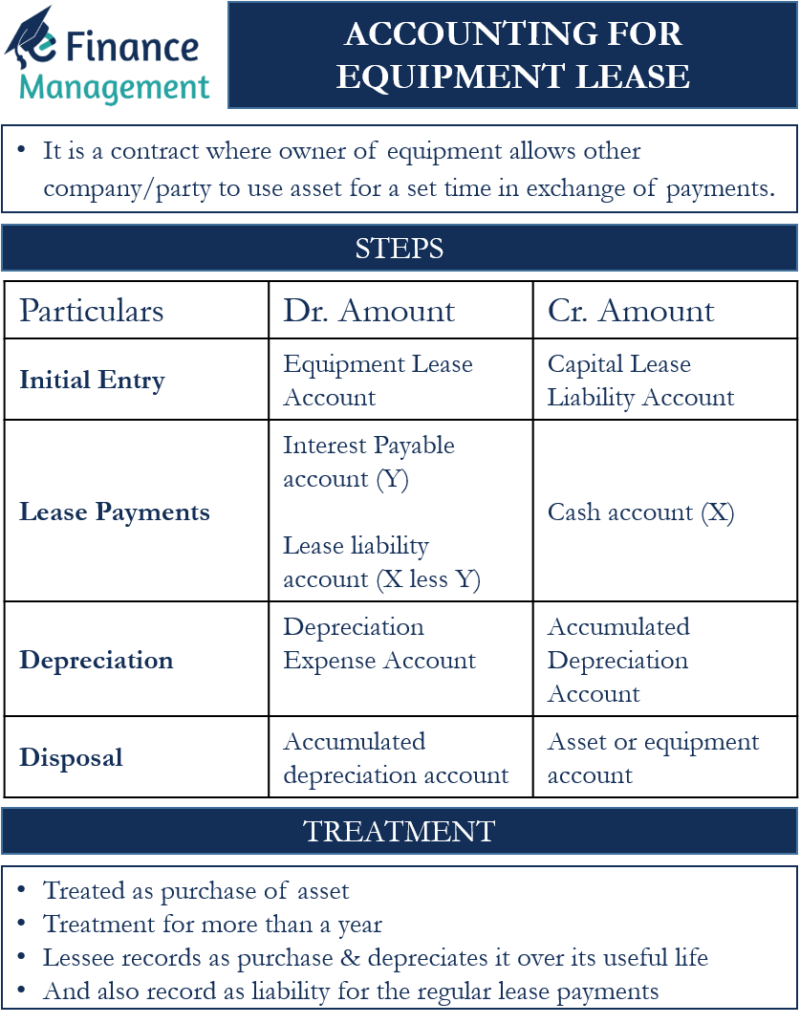
A capital lease is a contract entitling a renter to the temporary use of an asset, and such a lease has the economic characteristics of asset ownership for accounting purposes. The tax benefit of a capital lease often comes in the form of accelerated depreciation. Sec 179 and bonus depreciation allows companies to take a larger deduction for assets, regardless if the asset is fully paid with cash. This means that a piece of equipment that was leased during the year can be fully or partially deducted against income even if only a few lease payments were made. This works well with companies who want to get the benefit of purchasing equipment but don’t want the negative impact on cash flow.
Mastering the Books: How to Account for Leased Equipment
- However, you can claim a section 179 deduction for the cost of the following property.
- For 3-, 5-, 7-, or 10-year property used in a farming business and placed in service after 2017, in tax years ending after 2017, the 150% declining balance method is no longer required.
- The special depreciation allowance is also 60% for certain specified plants bearing fruits and nuts planted or grafted after December 31, 2023, and before January 1, 2025.
- The corporation first multiplies the basis ($1,000) by 40% (the declining balance rate) to get the depreciation for a full tax year of $400.
If no depreciation was deducted, the adjustment is the total depreciation allowable prior to the year of change. A negative section 481(a) adjustment results in a decrease in taxable income. It is taken into account in the year of change and is reported on your business tax returns as “other expenses.” A positive section 481(a) adjustment results in an increase in taxable income. Make the election by completing the appropriate line on Form 3115.
Operating Leases vs. Capital Leases & Depreciation
However, it involves a deeper analysis of long-term financial implications, including how each option affects depreciation, balance sheets, and cash flow. You’ll need to know the ins and outs, from deductions you can claim to how to report can you depreciate leased equipment your leased assets. Whether you’re a seasoned business owner or just starting, staying informed will help you avoid any pitfalls and keep your finances in check. Let’s dive into what you need to know about IRS rules for leased equipment.
Role of IRS & Accounting Standards in Defining Depreciation for Tax Purposes
Sankofa, a calendar year corporation, maintains one GAA for 12 machines. Of the 12 machines, nine cost a total of $135,000 and are used in Sankofa’s New York plant and three machines cost $45,000 and are used in Sankofa’s New Jersey plant. Assume this GAA uses the 200% declining balance depreciation method, a 5-year recovery period, and a half-year convention. Sankofa does not claim the section 179 deduction and the machines do not qualify for a special depreciation allowance.
Business News Daily provides resources, advice and product reviews to drive business growth. Our mission is to equip business owners with the knowledge and confidence to make informed decisions. As part of that, we recommend products and services for their success. Contact us to learn about our leasing program, or check it out for yourself. Underestimating the value of professional advice is all too common.

Claiming the Special Depreciation Allowance
The total bases of all property you placed in service during the year is $10,000. The $5,000 basis of the computer, which you placed in service during the last 3 months (the fourth quarter) of your tax year, is more than 40% of the total bases of all property ($10,000) you placed in service during the year. Therefore, you must use the mid-quarter convention for all three items. During the year, you bought a machine (7-year property) for $4,000, office furniture (7-year property) for $1,000, and a computer (5-year property) for $5,000. You placed the machine in service in January, the furniture in September, and the computer in October. You do not elect a section 179 deduction and none of these items is qualified property for purposes of claiming a special depreciation allowance.
Using depreciation, a business expenses a portion of the asset’s value over each year of its useful life, instead of allocating the entire expense to the year in which the asset is purchased. Duforcelf, a calendar year corporation, maintains a GAA for 1,000 calculators that cost a total of $60,000 and were placed in service in 2020. Assume this GAA is depreciated under the 200% declining balance method, has a recovery period of 5 years, and uses a half-year convention. Duforcelf does not claim the section 179 deduction and the calculators do not qualify for a special depreciation allowance. In 2022, Duforcelf sells 200 of the calculators to an unrelated person for $10,000.
The use of your own automobile or a rental automobile is for the convenience of Uplift and is required as a condition of employment. When you dispose of property that you depreciated using MACRS, any gain on the disposition is generally recaptured (included in income) as ordinary income up to the amount of the depreciation previously allowed or allowable for the property. In May 2023, Sankofa sells its entire manufacturing plant in New Jersey to an unrelated person.
Qualified business use of listed property is any use of the property in your trade or business. Whether the use of listed property is for your employer’s convenience must be determined from all the facts. The use is for your employer’s convenience if it is for a substantial business reason of the employer. The use of listed property during your regular working hours to carry on your employer’s business is generally for the employer’s convenience. If these requirements are not met, you cannot deduct depreciation (including the section 179 deduction) or rent expenses for your use of the property as an employee.
